Animals Around Tree Painting Drawing
Pastel Journal received some great feedback from a letter published in the Apr 2012 issue of the magazine on how to pigment animals from image references. Have any more ideas? Leave them in the comments field below.
I've only received the latest event of Pastel Journal, equally well as the online feature. The pieces on Steve Morvell's wonderful wildlife pastels fill me with adoration.
For the most part, I practice pastel animal paintings and portraits of people, working from life and photographs (more than photos than life; animals won't sit still). I would love to do more wild animals work. But if you don't have the opportunity or the money to visit wild places, and if you're somewhat physically handicapped, equally I am, how practise you get image references?
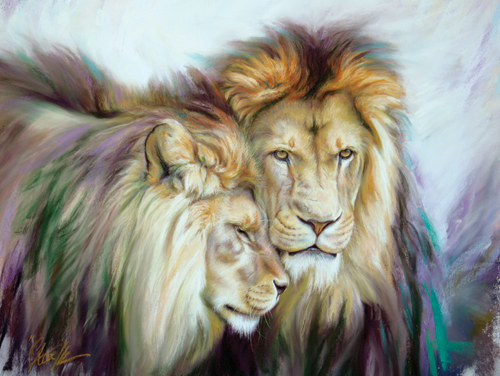
You can't use other people's photos—well, y'all tin can if you lot get permission, simply even if you practise, you tin't, for example, enter a contest with the finished work.
Is in that location an answer to this?
Give thanks you,
Diane M. Smith
•••••
Hi,
I'thou writing in reference to the letter in your April 2012 issue from Diane Smith. I'yard a professional wild fauna artist with dual residency in the states and Brazil, and am fortunate to have access to my subject affair in the beautiful Atlantic Woods area where I live. I have e'er insisted on taking my ain reference shots, that is, until I was asked to create the illustrations for the children's book WISDOM, the Midway Albatross (www.albatross.darcypattison.com). Unable to travel to Midway Atoll to certificate the life wheel of these amazing birds, I was able to use the photography provided by the U.South. Fish and Wildlife Service at their site because it's in the public domain: http://digitalmedia.fws.gov.
I hope this helps Diane in her passion for wild animals painting. As far as competitions go, not all of them require that you use your own reference textile, and possibly public domain reference photos are allowed in others.
Congratulations on an excellent and inspiring magazine !
Kitty Harvill, AFC
•••••
Here are my suggestions for Diane Chiliad. Smith on how to pigment animals when you're living with disabilities and can't get into the great outdoors. I'm too a disabled wildlife artist with mobility limitations, so I have come up with quite a few strategies that work.
1. Join www.wetcanvas.com. The Reference Image Library is priceless. Artists from effectually the world with a lot more mobility and better cameras than I can afford take posted so many gorgeous references for utilise by members without royalties that information technology's where I turn first. It's rare that I can't find the animal or bird I'm looking for and good references of the places it lives.
ii. Sketch like animals in or near your house for exercise. I got much meliorate at big cats by doing thousands of quick gesture studies of my cat. Sparrows take a lot in common anatomically with other birds. Life sketching volition help when the reference for that eagle is in an bad-mannered position, but 1 of your sparrow sketches has the pose you want.
three. Sketch wildlife from videos every bit if y'all were drawing from life. It's off-white to play the prune over and over, but it's most similar life drawing if yous merely loop the clip rather than freeze frame on a good pose. This helps build anatomy skills and observation. Very often you'll pick upward more virtually the fauna and its environment than the narrator says past paying close attending to clips.
iv. Visit zoos in your area, even if it takes renting a wheelchair and getting a friend or relative to push it. If yous're going to sketch from life, yous don't need to walk through the whole zoo. Get directly to your favorite subject and spend half the day by that muzzle. Be sure to bring sunscreen and vesture a wide brim hat—otherwise, take the usual going outdoors precautions.
five. If you take power mobility, check local and state parks for whether some paved trails run in areas you lot want to paint. Sometimes wonderful scenes and good wildlife come to those who wait—even if you're waiting on a paved flake rather than half a mile out into the woods. It doesn't matter how y'all get at that place or whether you only go in adept weather; if you tin can do any outdoor painting or sketching at all, this helps requite yous good reference materials. What you see that's too fleeting to sketch from life, try to draw it immediately. The act of sketching a fresh memory helps set up information technology into long-term memory.
6. Buy good books on wild animals painting and drawing. Study them and do the exercises. Copying the masters will help teach you lot what to look for when you're drawing a existent, moving target.
7. Practise lots of fast, timed gesture sketches from every source. Every time yous sketch, you lot're observing the animal fresh. Yous'll see something you didn't the concluding time. Five three-minute sketches will teach you much more than a detailed 15-minute sketch.
8. Don't be shy most contacting nature photographers online! You don't know if they'll exist happy to give permission to draw until you ask. About of them do give permission. I always credit them fifty-fifty if they say they don't care, because their references are important. Many also want to see the painting once I've washed information technology, so I proceed their name on file and keep contact information. Some photographers accept given me coating permission to describe from all their photos. A very few want royalties or hefty fees, only there are so many who requite permission without charging annihilation that I just move on and find a new reference.
nine. Combine so many unlike references and studies that no one can tell what yous used as a reference. If you aren't copying anyone's photo but checking the color in this one, background from ii others, proportions in some other, face details in a close-up, pose from another that might exist a unlike species, you'll come out with an original painting.
10. When entering contests, read the fine print. Contests vary. Many simply say "your own photos or references used with permission." A few purist contests don't want you using any reference photos, merely if y'all used your sketches equally references and any photo references are second or third remove, that would probably satisfy fifty-fifty those purists. This is where zoo trips, life sketching birds at your feeder and pets in the house come in handy. It's good to accept those sketch references handy if your painting is questioned because by coincidence some photographer captured a tiger in your cat's favorite pose.
There are places in the world that even athletic, abled wildlife painters have a difficult time visiting, conditions then difficult to paint in that the hardiest rely on photos and videos. For some nature subjects, similar extinct animals, all you tin can do is study nature and extrapolate from the known species to put mankind and feathers on the old bones. Nosotros may face some special obstacles considering information technology'due south harder to get out into fields and woods on bad days, only painting nature is a manner to connect with the wilderness even when shut in.
Robert A. Sloan
•••••
I'm not a wild fauna artist, simply I enjoy National Geographic's Nat Geo Wild TV channel and highly recommend it. There is also a serial of six programs on Wild Russia available in high definition, as well as others. Buying them is cheaper than traveling! Watching such a series over and over lets you learn how an brute moves, which helps with proportion besides as pose. It besides gives yous the correct habitat. When y'all've learned to sketch the animal accurately you lot tin can always go to the Net for details similar whiskers and tails.
Nova Wells
•••••
I read my wife's response to your desire for info on wildlife photography and wanted to add my comments. I similar to take pics with my NIKON D-50 and a couple of small-scale zoom lenses. We attended a lodge presentation a couple of years ago at the Loveland, Colo., Camera Club. Speaker was a well-known wild fauna photographer who has been published several times in National Geographic, and he addressed the full general question: How do you take practiced wild animals photos? His directly respond assumes basic knowledge of your photographic camera and accessories, which you can gain in your home. His respond: Go where the wildlife is friendly! One of his solutions is a trip to Rocky Mountain National Park, where crowds of people go in the fall to hear Elk trumpet. While all the same wild, the animals there are used to people and don't automatically turn tail and run when people are effectually.
I'd like to add a couple of thoughts: If yous accept a yard where you live, you tin can see and photograph wildlife there. I have a couple of bird feeders in my backyard, along with an inexpensive h2o fountain, which trickles water into a minor bowl. Information technology gets replaced with an ordinary waterer with a thermostatically controlled warmer that kicks in when the air temp nears the frost-mark. We run into lots of birds of course—some of which pose for us, and we learn to anticipate their behavior. Chickadees, for instance, won't pose—they come to the feeder, grab a seed and flit correct upwards to a co-operative in a nearby tree to eat the seed. Yous'll need some kind of a blind. Quickest and least expensive is some camo-colored netting from a cloth store. Improvise some kind of a frame with sticks or poles—a teepee comes to mind. Shoot through the door where the fabric overlaps.
I suspect y'all tin can search Google for some skilful ideas about feeding stations, and appropriate seeds for your location. Birds hither in northern Texas like black oil sunflower seeds. Of course, our home is a good blind, with the camo netting for a drape we can shoot through. Birds can requite you a gamble for some really proficient wildlife photos and bird paintings.
Enjoy your adventure!
Carl Wells
•••••
For the woman who needed pictures to work from: She can buy them from an paradigm service! Some of the services, such every bit Fotolia, have cheap monthly fees for a certain number of photos a month.
–Eileen McHargue
•••••
* Yous'll detect a total-length feature on wild animals and conservation-inpsired pastelist Steve Morvell in the Feb 2012 issue of Pastel Journal. (Have you renewed your subscription to the mag? You're just 1 click abroad from a year's worth of pastel inspiration and instruction.)
Relish an online-sectional gallery of Morvell's pastel animal paintings here.
Exercise you lot accept more ideas on images sources for painting animals and wild fauna? Add them in the comments field below.
MORE RESOURCES FOR PASTEL ARTISTS
• Subscribe to Pastel Periodical mag
• Watch pastel art workshops on demand at ArtistsNetwork.TV
• Get unlimited access to over 100 art pedagogy ebooks
• Online seminars for fine artists
• Find pastel painting downloads, books, videos & more than
• Sign up for your Pastel Periodical e-mail & download a FREE issue of Pastel Journal magazine
Source: https://www.artistsnetwork.com/art-mediums/pastel/where-the-wild-things-are/
0 Response to "Animals Around Tree Painting Drawing"
Post a Comment